What You Need to Know Before You MoveConsidering a move to Colorado Springs? One of the first questions you'll probably ask is, 'How much does it cost to live there?'Colorado Springs continues to

Dated: June 24 2025
Views: 1105
Compass argues this policy unfairly penalizes sellers and brokerages using its three-phase listing strategy:
Private Exclusive listings shared only within Compass.
Coming Soon listings published on Compass.com.
MLS syndication, following the first two phases
Compass says this method helps sellers test market interest, manage pricing, and avoid "days on market" stigma. They claim Zillow is effectively "banishing" their listings for daring to use it, calling it coercion under the guise of transparency
Zillow defends the rule as a means to ensure open market access for buyers and sellers. They argue the policy:
Maintains consistent exposure for every listing,
Supports industry norms like the National Association of Realtors' "clear cooperation" standard,
Prevents fragmented, confusing markets where some buyers lose out on seeing available homes
Zillow, backed by consumer advocates and brokerages, claims the rule levels the playing field—ensuring fairness rather than advantage
For Sellers:
Sellers choosing Compass’s model gain flexibility in pricing, market testing, and privacy during hidden or early launch phases.
Sellers leaning toward Zillow’s rule benefit from maximum listing visibility, which may attract more offers but can raise concerns like public "days on market" or price-drop signals
For Buyers:
Zillow’s approach ensures broader visibility—buying confidence that you're seeing everything.
Compass supporters might contend that phased marketing creates early buyer opportunities, though at the risk of information asymmetry.
For the Market:
A Compass win could legitimize varied listing strategies, giving brokerages more creative latitude.
A Zillow win could standardize listing release timelines and reinforce MLS-as-central hub norms.
Compass is seeking an injunction to stop Zillow's policy, alongside damages and a jury trial Zillow intends to vigorously defend, framing the lawsuit as baseless . Expect this to be a protracted court saga, with wider implications for broker-platform power dynamics and seller rights.
This dispute centers around a fundamental question: Should sellers and brokerages have the freedom to use phased, private listing strategies, or should platforms like Zillow enforce uniform access to listing exposure?
If you prioritize maximum reach and standard exposure, Zillow’s stance may offer peace of mind.
If you care more about flexibility in marketing, privacy, and staging, Compass’s model may appeal—if the courts side with them.
In either case, your brokerage choice matters. Agents' strategies and their relationship with listing platforms could directly affect your home's marketing and ultimate sale. This case could tip the balance of power in how real estate is bought and sold.
============================================================
Colorado sellers—and yes, that includes those working with Compass-style phased listings—need to be crystal clear on one critical question:
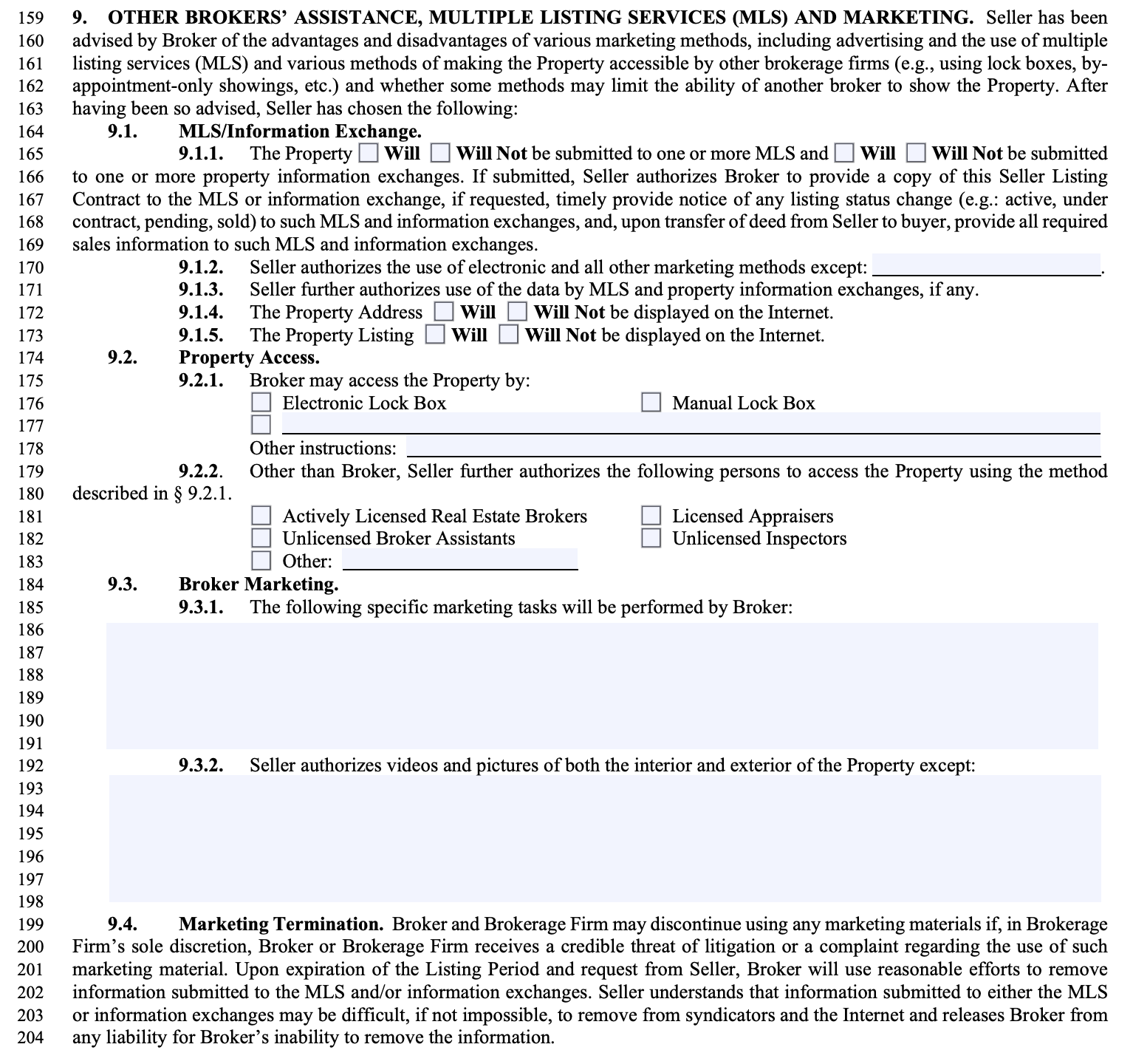
Do you want your property submitted to the MLS and syndicated broadly, or not? (The relevant section of the "Exclusive Right To Sell (LC50-8-24) (Mandatory 8-24)" is shown at the bottom of this Blog)
You, the seller, choose one of two paths:
MLS / Information Exchange
☐ Yes: Broker will submit your property to one or more MLS systems and syndicated platforms (e.g., Zillow, Trulia)—and publicly display your address and listing.
☐ No: Broker will not submit your listing to MLS or other syndicated platforms; your listing will remain internal to the brokerage.
Marketing Authorization
Regardless of MLS choice, you authorize the broker to use electronic marketing (e.g., your listing on the brokerage's app or internal website).
But if you choose "No" to MLS syndication, that electronic marketing stays within the brokerage only—including any sister companies.
You also choose the access method for showings:
Lock box (electronic or manual)
Appointment-only
With or without third-party access (e.g., licensed brokers, appraisers, inspectors)
You and your broker clarify which exact marketing actions they’ll take, including any photos or videos—except anything you specifically remove from authorization.
The broker reserves the right to stop or remove marketing materials if there’s a credible complaint or litigation threat. You also give up any liability for information that’s already syndicated and can’t be fully pulled back.
A. You Choose “Yes” to MLS (Maximum Exposure)
Your listing shows up on MLS, Zillow, Trulia, broker websites, and everywhere.
Pros: Most buyers see your home. Likely more showings, higher offer activity.
Cons: Days-on-market counts begin immediately. Competitors can quickly access and match your price.
B. You Choose “No” to MLS (Broker-Only Exposure)
Only your brokerage’s agents can access or show the property.
Pros: Enhanced privacy and control. No risk of public “days on market” or price adjustments showing in public systems.
Cons: Massive pool of buyers—those out with other agents or actively searching online—can’t see or inquire about your home.
Important: Listing you rely on “internal-only” marketing can’t be shared by other agents—even sister companies of your brokerage. That severely limits potential buyer reach.
Ask your broker:
What’s your overall strategy?
Have they got experience with silent or broker-only listings?
Which buyers would you be missing out on if you skip the MLS?
Evaluate trade-offs:
Want full market visibility and potentially faster sale? Go MLS.
Prefer discretion, staging, or soft launch before opening to wider audience? Consider internal-only (with strong buyer network).
Remember compliance matters:
Colorado law makes sure you make this choice consciously.
Your decision can't be ignored, and agents are obligated to honor your preference under the standardized DORA contract.
Section 9 gives you a seat in the driver’s seat on how—and with whom—your property is marketed. Neither option is automatically “best.” It comes down to:
Exposure vs. Control: Want to reach every buyer vs. keeping showings tight and stealthy.
Rapid sale vs. Strategic staging: Public listing may sell faster, but silent launches let you finesse pricing and presentation before going wide.
Take this decision seriously—your agent should help you make an informed choice that fits your priorities and timeline.
If you would like more information, don't hesitate to reach out directly or add a comment to this blog post.

I’m originally from the UK, from Irish parents, and yes, I still sound like someone who’s either about to sell you a house or narrate a BBC documentary. I moved to Colorado in 2017 with my....
What You Need to Know Before You MoveConsidering a move to Colorado Springs? One of the first questions you'll probably ask is, 'How much does it cost to live there?'Colorado Springs continues to
Advice from a local REALTOR® who has helped families relocate to Colorado Springs for more than a decade.Moving to Colorado Springs is exciting. Between the mountain views, outdoor lifestyle,
Thinking About Moving to Colorado Springs?If you're considering a move to Colorado Springs, you're not alone. Every year, thousands of families, military personnel, healthcare professionals, remote
Understanding the 21st Century Housing Act: What It Could Mean for Colorado FamiliesBy Andrew Drapeau, REALTOR® | JPAR Modern Real EstateOver the past several years, I've had conversations with
 The content relating to real estate for sale in this Web site comes in part from the Internet Data eXchange (IDX) program of METROLIST, INC., DBA RECOLORADO©. Real estate listings held by brokers other than JPAR® - Modern Real Estate are marked with the IDX Logo. This information is being provided for the consumers' personal, non-commercial use and may not be used for any other purpose. All information subject to change and should be independently verified. September 9, 2026 11:16 PM UTCd
1. This publication is designed to provide information regarding the subject matter covered. It is displayed with the understanding that the publisher and authors are not engaged in rendering real estate, legal, accounting, tax, or other professional services and that the publisher and authors are not offering such advice in this publication. If real estate, legal, or other expert assistance is required, the services of a competent, professional person should be sought.
2. The information contained in this publication is subject to change without notice.
METROLIST, INC., DBA RECOLORADO MAKES NO WARRANTY OF ANY KIND WITH REGARD TO THIS MATERIAL, INCLUDING, BUT NOT LIMITED TO, THE IMPLIED WARRANTIES OF MERCHANTABILITY AND FITNESS FOR A PARTICULAR PURPOSE. METROLIST, INC., DBA RECOLORADO SHALL NOT BE LIABLE FOR ERRORS CONTAINED HEREIN OR FOR ANY DAMAGES IN CONNECTION WITH THE FURNISHING, PERFORMANCE, OR USE OF THIS MATERIAL.
3. PUBLISHER'S NOTICE:
All real estate advertised herein is subject to the Federal Fair Housing Act and the Colorado Fair Housing Act, which Acts make it illegal to make or publish any advertisement that indicates any preference, limitation, or discrimination based on race, color, religion, sex, handicap, familial status, or national origin.
4. METROLIST, INC., DBA RECOLORADO will not knowingly accept any advertising for real estate that is in violation of the law. All persons are hereby informed that all dwellings advertised are available on an equal opportunity basis.
5. 
6. © 2026 METROLIST, INC., DBA RECOLORADO© - All Rights Reserved
6455 S. Yosemite St., Suite 500
Greenwood Village, CO 80111 USA
7. ALL RIGHTS RESERVED WORLDWIDE. No part of this publication may be reproduced, adapted, translated, stored in a retrieval system or transmitted in any form or by any means, electronic, mechanical, photocopying, recording, or otherwise, without the prior written permission of the publisher. The information contained herein including but not limited to all text, photographs, digital images, virtual tours, may be seeded and monitored for protection and tracking.
Options
Show More...
 Information deemed reliable but not guaranteed by the MLS. © 2026 Information and Real Estate Services, LLC.
Information source: Information and Real Estate Services, LLC. Provided for limited non-commercial use only under IRES Rules. © Copyright IRES.
The information being provided is for the consumers personal, non-commercial use and may not be used for any purpose other than to identify prospective properties consumer may be interested in purchasing.
The IRES, LLC Data on this
site was last updated: September 9, 2026 11:14 PM UTC
Information deemed reliable but not guaranteed by the MLS. © 2026 Information and Real Estate Services, LLC.
Information source: Information and Real Estate Services, LLC. Provided for limited non-commercial use only under IRES Rules. © Copyright IRES.
The information being provided is for the consumers personal, non-commercial use and may not be used for any purpose other than to identify prospective properties consumer may be interested in purchasing.
The IRES, LLC Data on this
site was last updated: September 9, 2026 11:14 PM UTC
This site is used and paid for by multiple independent companies. The real estate broker cannot require you as a prospective buyer to pre-qualify with or utilize the services of either of the mortgage loan originators. Nor can either of the mortgage load originators require you as a prospective buyer to utilize the services of the real estate broker.
Show More...
 The real estate listing information and related content displayed on this site is provided exclusively for consumers’ personal, non-commercial use and may not be used for any purpose other than to identify prospective properties consumers may be interested in purchasing. This information and related content is deemed reliable but is not guaranteed accurate by elevateMLS.
